Showing posts with label fMRI. Show all posts

27 December 2012

Effective Screening for Alzheimer's Disease Through MRI of the Cerebrospinal Fluid


Using Magnetic Resonance Imaging (MRI) can screen patients for alzheimer's disease effectively. MRI is non-invasive and cost efficient which may be useful to track and monitor the disease as well as observe new treatments for it.

MRI is an imaging application that is usually used in the medical field. It uses magnets and radiowaves to construct an internal 3D image of the target.

MRI has been useful throughout the years in imaging the human body in detail and can also be observed in real time. It tracks the magnetic field of atomic nuclei in the body and is then detected by a scanner that uses it to construct an image.

MRI is also used to effectively image the human brain as well as detect neural activity within it through MRI based imaging techniques such as fMRI (functional MRI) and DTI (Diffusion Tensor Imaging).

The new study on detecting Alzheimer's disease through MRI is an significant step for neurological research. Previous tests for the disease requires a cognitive assessment by the doctor through tests as well as a review of the patient's clinical history and neurological and neuropsychological observations.

20 December 2012

Understanding How The Brain Spatially Represents Object and Action Categories Through fMRI


Scientists uses functional magnetic resonance imaging (fMRI) to study blood and oxygen flow in the brain when it processes and categorizes objects and actions. They are studying how the data is represented spatially in the brain.

Magnetic Resonance Imaging uses the magnetic properties of atomic nuclei to construct a 3 dimensional computer image of the target object. It is a non-intrusive and non-lethal way to image the innermost parts of the body.

Unlike an x-ray where the patient should ingest a trackable isotope for the x-ray to image, the patient in an MRI process just have to lie perfectly still while the MRI's powerful magnets scan the body.

An offshoot to MRI, is functional magnetic resonance imaging or fMRI. With fMRI, doctors track the bloodflow in the patient's brain. This is useful to understand how the brain works and reacts to certain actions, behaviors or stimuli.

fMRI helps scientists understand what part of the brain processes a certain action such as identifying smell, recognizing faces, or even remembering certain memories. Doctors analyze this by identifying what part of the brain has increased blood flow activity during the experiment.

Graphical Visualization of the Group Semantic Space (see Note 1)
Credit: Huth et al., Neuron

15 November 2012

The Science of Rap: Studying fMRI Brain Activity While Freestyling


Researchers study the brain activity, through functional magnetic resonance imaging (fMRI), of rappers while freestyling. The study tries to focus on how the brain works during an activity where creativity, language, and artistic expression are all combined.

Music is the language of the soul, that's how the saying goes. Some may discount rap and hip-hop as a minor subtext when it comes to music. But this type of music requires more brain resources during a performance than most other type of musical expression. Nothing merges music and language closer than freestyle rap.

18 October 2012

Using fMRI To Examine Brain Activity In Forgetting Memories Through Suppression And Substitution


Two neurologists used functional magnetic resonance imaging (fMRI) to examine the brain activity when volunteers attempt to forget memories by either blocking them out or recalling substitute memories.

Roland Benoit and Michael Anderson of the MRC Cognition and Brain Sciences Unit at the University of Cambridge found that these two mechanisms, substitution and suppression, are how the brain voluntary forget specific memories. This finding can lead to the development of treatments to improve disorders of memory control.

29 June 2012

Mind Reading Device Allow Mute and Disabled To Communicate With Others


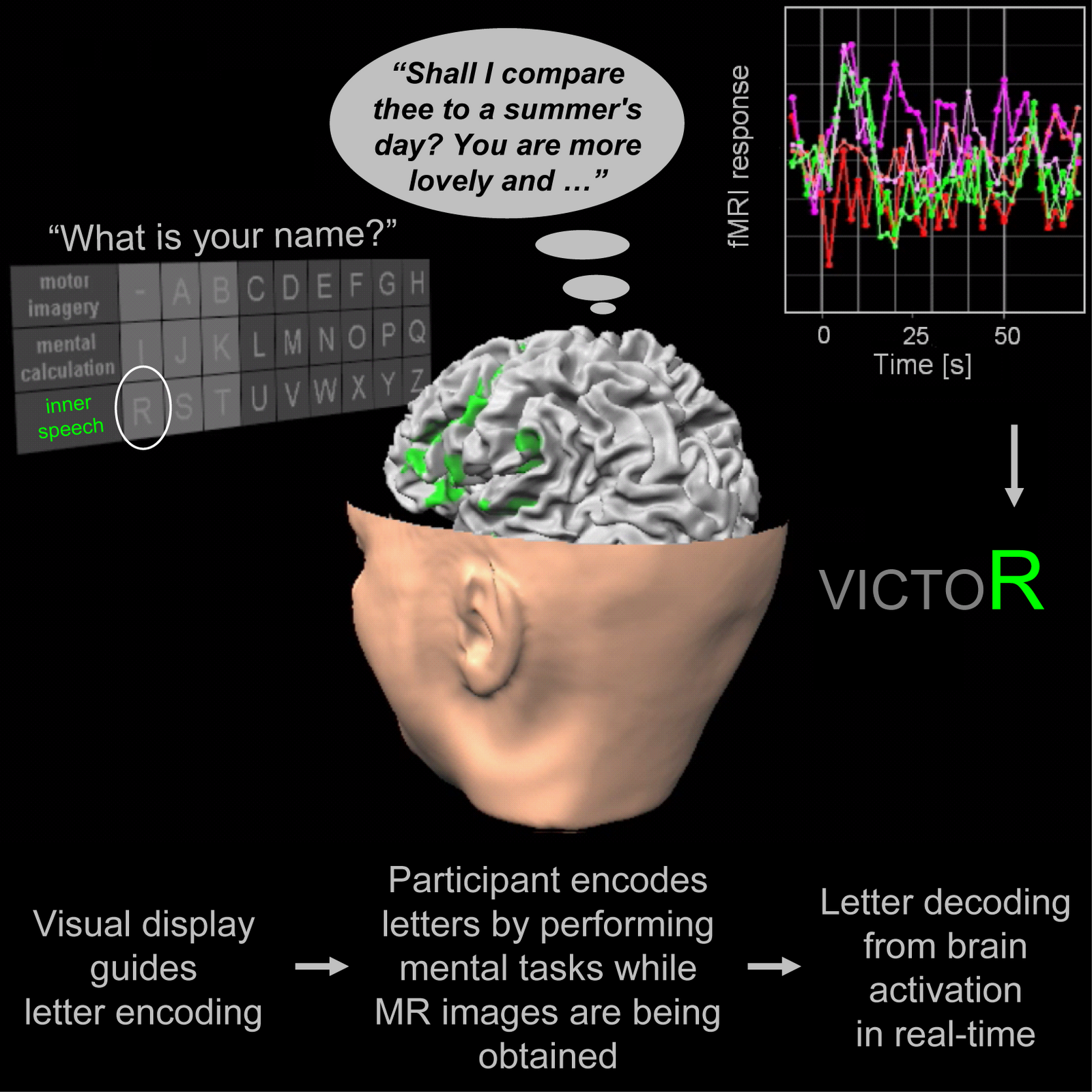
Researchers have come up with a device that may enable people who are completely unable to speak or move at all to nevertheless manage unscripted back-and-forth conversation. The key to such silent and still communication is the first real-time, brain-scanning speller, according to the report published online on June 28 in Current Biology, a Cell Press publication.
Credit: Sorger et al.: Current Biology
Functional Magnetic Resonance Imaging or functional MRI (fMRI) is an imaging procedure using MRI technology that measures brain activity by detecting associated changes in blood flow.

fMRI is used to help diagnose brain diseases and disorders. It also helps doctors study the brain's mental processes to determine how the brain responds to thoughts and feelings.

The technology uses Magnetic Resonance Imaging (MRI). MRI uses radio waves and mgnetic fields are used to create the detailed images of the test subject. In fMRI, imaging is used to study the blood flow in the brain to detect areas of brain activity. A computer records the changes in the blood flow to show the brain was working in real time.

Using fMRI, researchers have developed a device that can help people who are mute or have difficulty speaking to converse with others.

With mind-reading speller, free-for-all conversations that are silent and still

Researchers have come up with a device that may enable people who are completely unable to speak or move at all to nevertheless manage unscripted back-and-forth conversation. The key to such silent and still communication is the first real-time, brain-scanning speller, according to the report published online on June 28 in Current Biology, a Cell Press publication.

The new technology builds on groundbreaking earlier uses of fMRI brain scans to assess consciousness in people described as being in an unconscious, vegetative state and to enable them to answer yes and no questions. fMRI (or functional magnetic resonance imaging) is typically used for clinical and research purposes to track brain activity by measuring blood flow.

"The work of Adrian Owen and colleagues led me to wonder whether it might even become possible to use fMRI, mental tasks, and appropriate experimental designs to freely encode thoughts, letter-by-letter, and therewith enable back-and-forth communication in the absence of motor behavior," said Bettina Sorger of Maastricht University in The Netherlands.

Video: Mind Reading Speller